


A Jungian and trauma-informed reading of the Upside Down
When Stranger Things first aired, it was framed as nostalgic sci-fi.
Monsters. Portals. Government experiments gone wrong.
But beneath the storyline is something far more intimate — and far more unsettling.
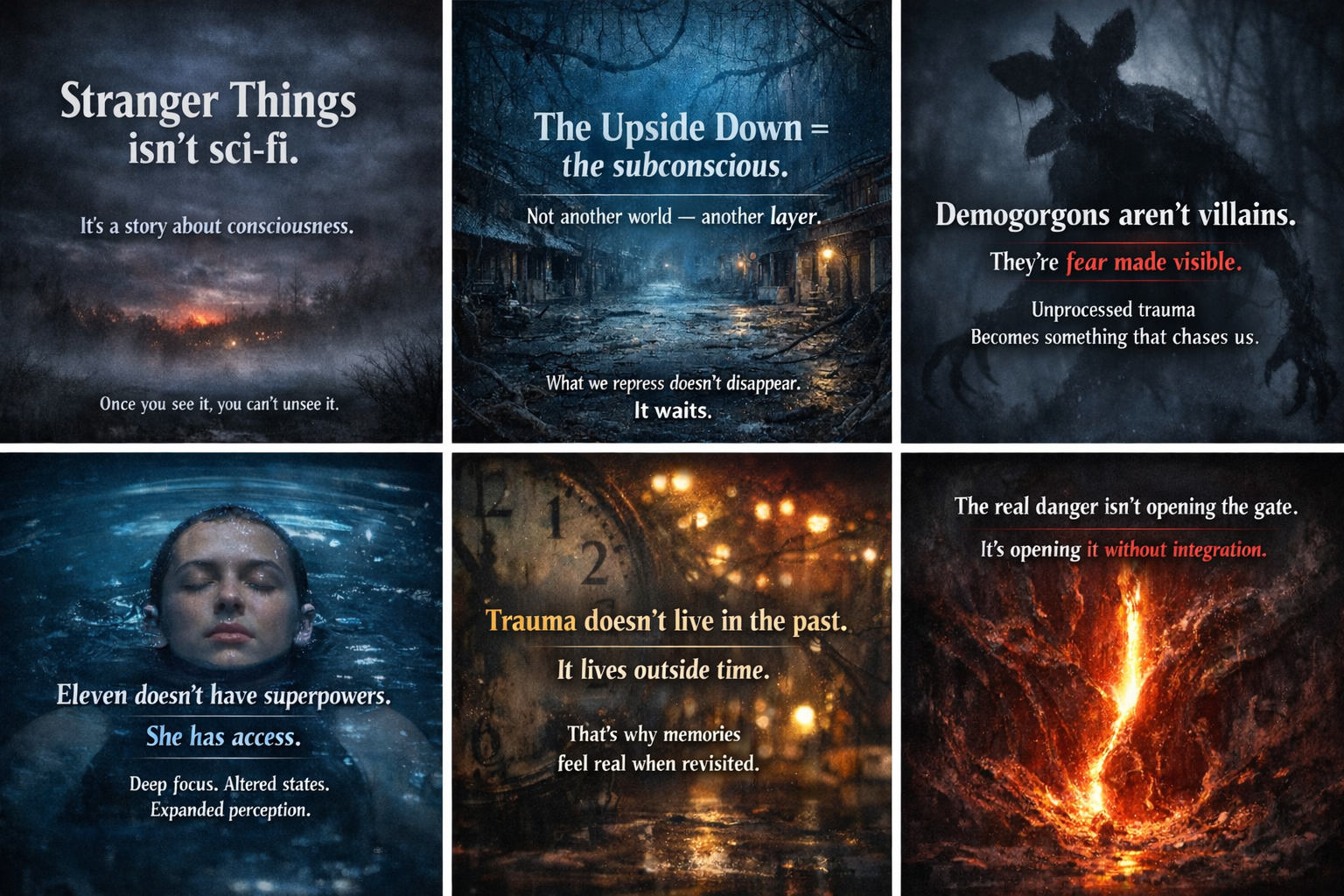
Stranger Things isn’t about another world invading ours.
It’s about what happens when inner worlds are ignored.
The Upside Down as the Jungian Shadow
Carl Jung described the shadow as the parts of the psyche that are repressed, denied, or split off in order for the ego to function. The shadow isn’t evil — it’s unlived, unintegrated, and therefore unconscious.
The Upside Down functions exactly like this.
It mirrors the real world, but distorted.
Familiar, yet decayed.
Frozen in time, yet emotionally charged.
In Jungian terms, the Upside Down is the collective shadow — not just personal repression, but shared, cultural, and intergenerational material that hasn’t been metabolised.
What we refuse to see doesn’t vanish.
It moves underground.
Trauma Doesn’t Live in the Past — It Lives in the Nervous System
Modern trauma theory supports what Jung intuited long before neuroscience caught up.
Trauma is not stored as a narrative memory.
It’s stored as sensory fragments, emotional charge, and nervous-system activation.
This is why trauma feels timeless.
Why it can be triggered instantly.
Why the body reacts before the mind understands.
In Stranger Things, when the gate opens, characters experience:
- Headaches
- Hallucinations
- Emotional volatility
- A breakdown of ordinary perception
These are classic signs of unintegrated material breaching conscious awareness.
The Upside Down doesn’t represent “the past.”
It represents experience that was never processed.
Monsters as Fear-Forms (Not Villains)
The monsters in Stranger Things behave less like external enemies and more like psychological complexes.
Jung described complexes as emotionally charged clusters of thought and feeling that operate autonomously — almost as if they have a will of their own.
Sound familiar?
The Demogorgon:
- Grows stronger when fed by fear
- Hunts compulsively
- Cannot be reasoned with
- Returns until confronted
This is how unintegrated trauma behaves.
It doesn’t disappear because we ignore it.
It escalates.
What we don’t integrate becomes symptomatic — anxiety, compulsion, repetition, projection. Or, in symbolic language: monsters.
Eleven and Altered States of Consciousness
Eleven isn’t powerful because she’s special.
She’s powerful because she has access.
Through isolation, sensory deprivation, and deep focus, she enters altered states of consciousness — states long recognised in:
- Yogic traditions
- Meditation research
- Psychedelic-assisted therapy
- Somatic trauma work
In these states:
- Time collapses
- Distance dissolves
- Memory becomes spatial
Neuroscience shows that in deep altered states, the default mode network quiets, allowing access to subconscious material. This is why trauma memories, intuition, and non-linear perception emerge.
Eleven doesn’t “travel to another world.”
She enters the unconscious without filters.
The Real Danger: Awareness Without Integration
This is the core warning of Stranger Things.
The danger isn’t opening the gate.
The danger is opening it without integration.
In Jungian psychology, confronting the unconscious without adequate ego strength leads to inflation, fragmentation, or psychosis.
In trauma work, insight without nervous-system regulation leads to re-traumatisation.
Awareness alone is not healing.
Healing requires containment, embodiment, and integration.
This applies personally — and collectively.
When societies open psychological, technological, or spiritual “gates” faster than they can integrate them, the shadow doesn’t disappear.
It externalises.
Unseen Doesn’t Mean Evil
This is perhaps the most misunderstood part.
The Upside Down isn’t evil.
It’s unprocessed.
Jung warned that when the shadow is denied, it is projected outward — onto enemies, monsters, or imagined threats.
What we call “evil” is often disowned pain seeking form.
And what we don’t integrate eventually integrates itself — through breakdown, symptom, or crisis.
The Real Work
Stranger Things isn’t a warning about other dimensions.
It’s a warning about ignoring the inner one.
The work isn’t to close the gate.
The work is to integrate what’s behind it.
Because consciousness doesn’t ask permission when it wants to be seen.
- Shadow ignored becomes shadow in control.
- Awareness without integration destabilises both the psyche and the world.
- The monsters aren’t coming from another place. They’re coming from what we refused to feel.
Member discussion